Final
Houston Rockets at Dallas Mavericks
135 – 117
2026-27 · Preseason · Preseason
Game state source: whynba · Retrieved Oct 9, 6:06 pm EDTFinal
135 – 117
2026-27 · Preseason · Preseason
Game state source: whynba · Retrieved Oct 9, 6:06 pm EDTScheduled
2026-27 · Preseason · Preseason
Game state source: whynba · Retrieved Oct 9, 6:06 pm EDTFinal
110 – 114
2026-27 · Preseason · Preseason
Game state source: whynba · Retrieved Oct 9, 2:29 am EDTFinal
123 – 116
2026-27 · Preseason · Preseason
Game state source: whynba · Retrieved Oct 9, 2:29 am EDTFinal
118 – 128
2026-27 · Preseason · Preseason
Game state source: whynba · Retrieved Oct 9, 2:29 am EDTFinal
108 – 114
2026-27 · Preseason · Preseason
Game state source: whynba · Retrieved Oct 9, 2:29 am EDTFinal
111 – 109
2026-27 · Preseason · Preseason
Game state source: whynba · Retrieved Oct 9, 2:29 am EDTFinal
124 – 113
2026-27 · Preseason · Preseason
Game state source: whynba · Retrieved Oct 9, 2:29 am EDTA training-camp guide to NBA two-way contracts: roster places, active-list limits, the shared 90-game restriction and postseason conversion rules.

Denver’s September 30 signing of Ryan Nembhard is a useful reminder that a two-way deal comes with its own roster rules. A player can be part of an NBA organization, practice with its stars and contribute during the regular season while still needing a different contract to play in the postseason.
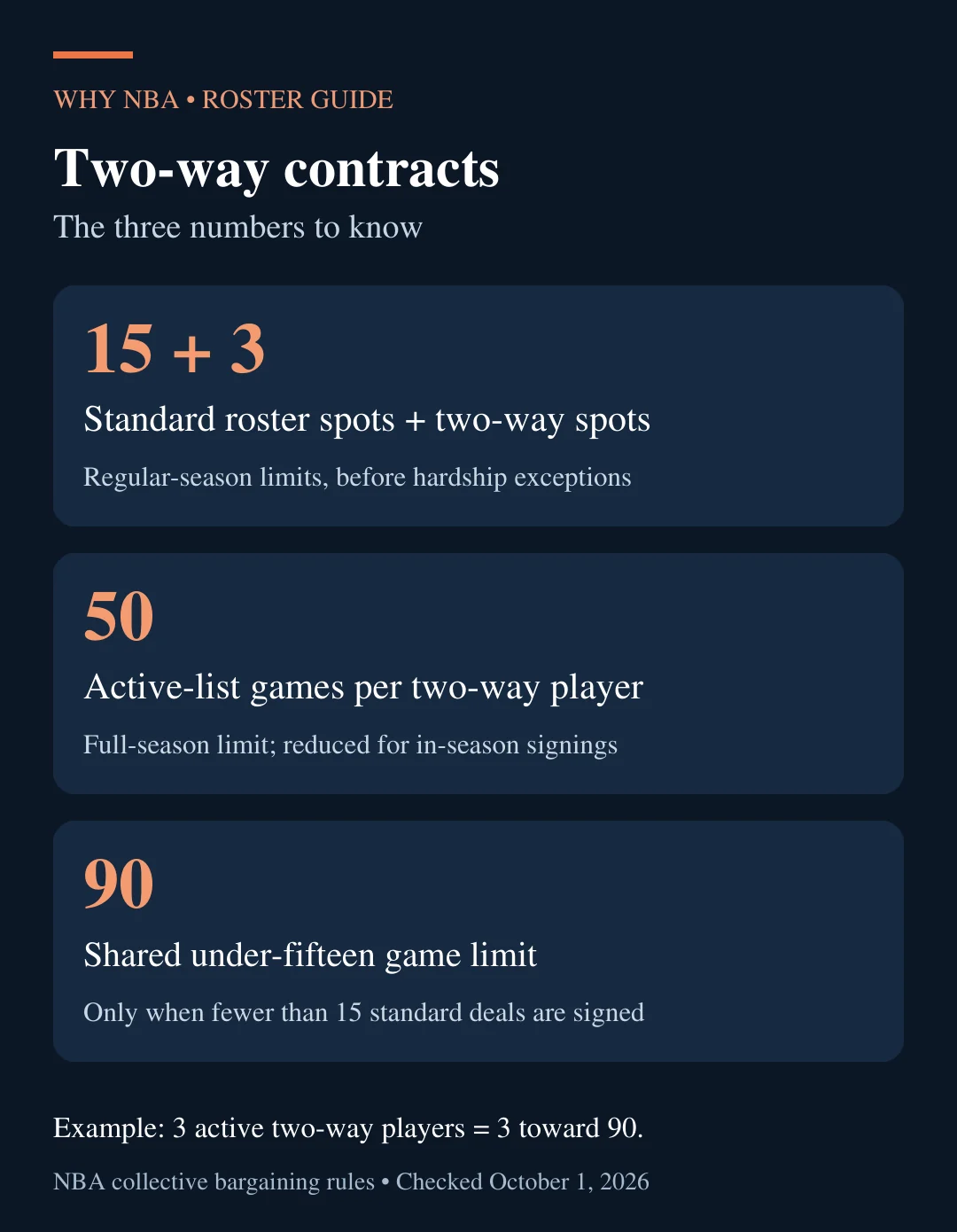
As training-camp rosters take shape, three numbers help explain the decisions: 15 standard contracts, three two-way places and a 50-game active-list limit. Here is how those rules fit together under the current NBA collective bargaining agreement.
NBA teams can carry up to three two-way players in addition to their usual maximum of 15 players on standard contracts. The larger offseason and training-camp roster can reach 21 players in total, so appearing on a September roster does not establish which kind of place a player will hold when the regular season starts.
For a two-way player, the arrangement allows service with both the NBA club and its G League affiliate. Denver’s affiliate is the Grand Rapids Gold. That development route is part of the context for the Nuggets’ Nembhard signing and corresponding KJ Simpson waiver request; the transaction itself does not promise a rotation role.
Two-way deals generally require fewer than four NBA Years of Service throughout the contract. This measures credited NBA service, not age or total overseas or G League experience. Terms can last one or two seasons, with no option year. A player who already has three service years cannot sign for two seasons.
A narrow one-season exception permits exactly four service years if a credited season involved an entire regular season on an NBA roster but no regular-season, Play-In or playoff appearance. With the same NBA club, two-way contracts may cover parts of at most three salary-cap years. Other eligibility limits still apply, including restrictions on returning to a team that traded or terminated a prior contract with protected pay.
The important word is active. A two-way player may be on his NBA team’s active list for up to 50 regular-season games under a full-season deal. It is not a guarantee of 50 appearances, starts or games with meaningful minutes.
For example, a player who is active but never leaves the bench still uses one game of that allowance. Tracking only the games-played column in a box score can therefore understate how much eligibility has been used. A contract signed after the regular season begins has a reduced limit, calculated from the portion of the season remaining.
Cleveland’s February 11, 2026 announcement of Nae’Qwan Tomlin’s conversion to a standard NBA contract illustrates the distinction. It said he had reached his 50-game active limit that season despite appearing in only 43 Cavaliers games. His box-score total therefore did not represent seven more games of two-way eligibility.
Updated October 9, 2026: Added this historical example of the difference between NBA appearances and active-list eligibility.
There is a second count when a team has fewer than 15 players signed to standard NBA contracts. In those games, its active two-way players collectively count toward a season-long limit of 90 “under-fifteen” games.
One active two-way player uses one unit of that shared allowance. Two use two; three use three. As a hypothetical, activating three two-way players in each of 10 such games uses 30 of the 90, even though the team has played only 10 games.
This is why the number of standard contracts matters alongside the number of two-way slots. The 90-game restriction and each player’s individual limit have to be monitored separately.
A player who remains on a two-way contract cannot participate in NBA postseason games, including the play-in. He can travel and practice with the team.
For postseason eligibility, the player must sign a standard NBA contract or have his two-way deal converted before the start of his team’s final regular-season game, subject to the other eligibility rules. Converting the deal requires a standard roster place; having an unused two-way slot does not solve that problem.
A player on a standard NBA contract can also be assigned to the G League. He keeps that NBA contract and roster place. A G League appearance alone therefore does not tell you that someone is on a two-way deal.
An Exhibit 10 attachment offers another route. It can let a team convert an eligible player’s contract to a two-way deal before the regular season begins. A camp signing with that attachment is not, by itself, confirmation that the conversion has happened.
When evaluating the next camp transaction, look for three things: the exact contract type, the NBA club’s available roster places and whether the announcement confirms a conversion. Those details say more about immediate eligibility than the word “signed” on its own.
Talk basketball. Keep it respectful. You can use a name or stay Anonymous. Comments publish immediately.

Be the first to start the conversation.